
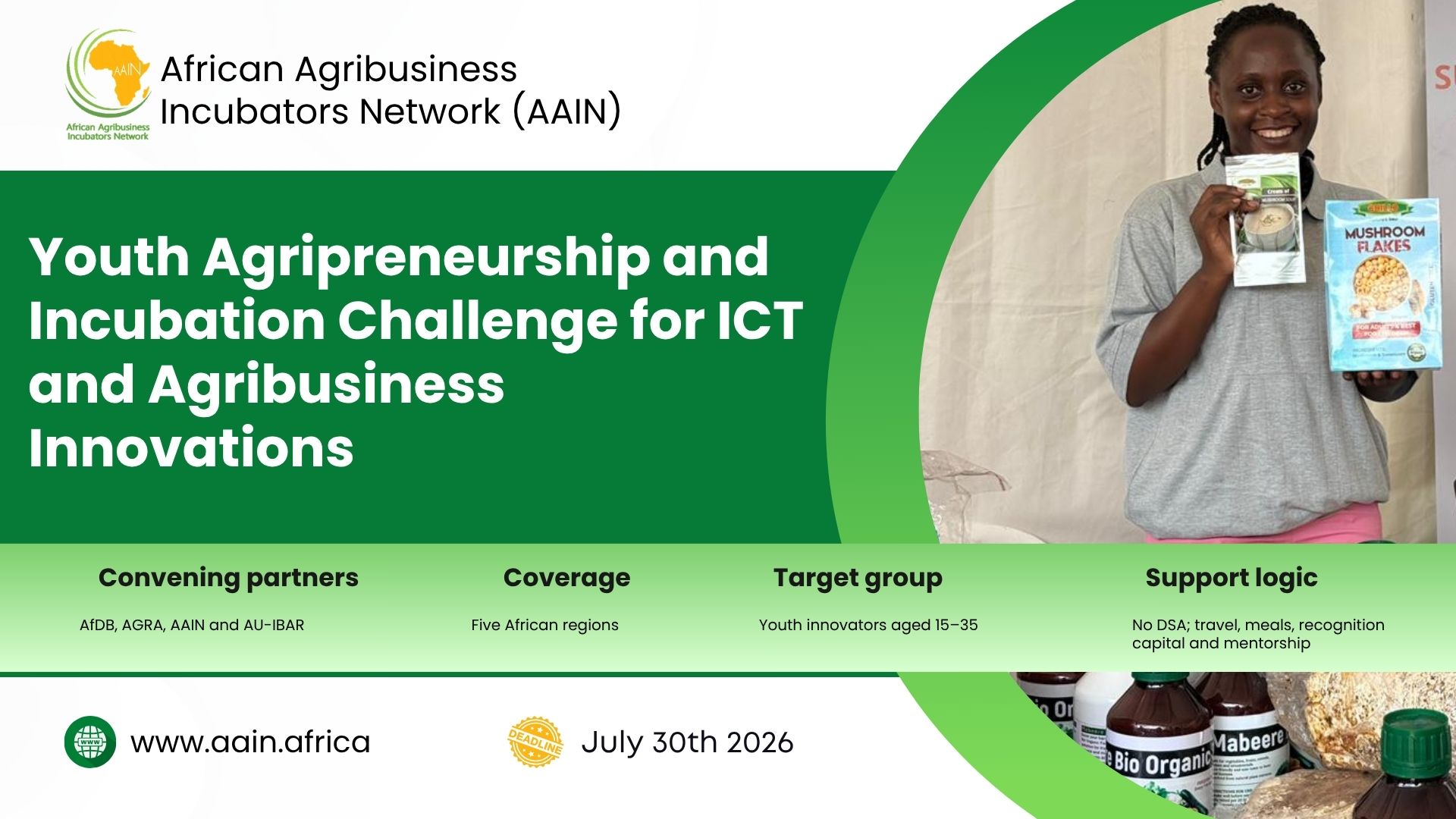
Youth Agripreneurship and Incubation Challenge for ICT and Agribusiness Innovations
Text by: Phiona Katushabe | Kampala, Uganda – June 3, 2026
1. Background and rationale
AAICE2026 provides a timely platform to convert youth agribusiness innovation into enterprise growth. The Conference will be held in Bujumbura, Burundi, from 3–8 August 2026 under the theme ‘Advancing Incubation and Acceleration Ecosystems for Job Opportunities in Africa’, and is expected to convene a broad ecosystem of incubators, investors, governments, private-sector actors and youth entrepreneurs. The proposed Challenge will use this platform to identify and support youth-led enterprises in ICT and Agribusiness from the five African regions.
Africa has more than 400 million young people aged 15–35, yet youth employment remains constrained; the ILO estimates that 53 million youth in sub-Saharan Africa were not in employment, education or training in 2023, while agriculture remains the largest source of youth employment in the region. Animal-resource value chains are therefore not marginal to the jobs agenda. They are a practical entry point for youth enterprise, food security, nutrition, value addition and market systems development.
The Challenge is designed as a catalytic enterprise-development instrument, not a conference attendance scheme. Support will cover return tickets and meals for selected youth, while recognition awards will be structured as small enterprise-starting capital to strengthen their businesses. Selected innovators will also be profiled, mentored and admitted into the Africa Youth in Livestock, Fisheries and Aquaculture Incubation Network (AYLFAIN).
2. Alignment with continental ambitions and AGRA priorities
The initiative directly supports the Kampala CAADP Declaration and CAADP Strategy and Action Plan 2026–2035 by contributing to youth empowerment, innovation, value addition, food systems resilience, investment mobilisation and private-sector-led agrifood transformation. The Challenge will help move continental commitments from policy language to visible youth enterprises.
45% | 50% | 3x | 30% |
Increase agrifood output by 2035 | Reduce post-harvest losses | Triple intra-African agrifood trade | Empower youth in agrifood systems |
Youth innovations that raise productivity in livestock, fisheries and aquaculture. | Solutions in cold chain, processing, logistics, quality animal health and food safety. | Market-linkage, aggregation and digital trade solutions for regional value chains. | A continental pipeline of youth enterprises linked to incubation and mentorship. |
3. Objective and Challenge Model
The objective is to identify, recognise and support high-potential youth-led innovations in crop livestock, fisheries and aquaculture agribusiness from Africa’s five regions, and connect them to visibility, mentoring, incubation networks and small catalytic enterprise capital through AAICE2026.
- Launch a continental call for youth-led innovations in crop, livestock, fisheries and aquaculture.
- Select a balanced group of innovators from North, West, Central, East and Southern Africa.
- Recognise outstanding innovations at AAICE2026 and provide small enterprise-starting capital instead of DSA.
- Profile and publish selected enterprises to improve visibility with investors, incubators and partners.
- Attach selected youth to mentorship and admit them into the Africa Youth in Livestock, Fisheries and Aquaculture Incubation Network.
4. Innovation Tracks
The Challenge will remain flexible, but applications will be organised around six innovation tracks:
Productivity and input solutions: feeds, genetics, animal and aquatic health, breeding, farm management and advisory services | Processing, value addition and food safety: packaging, cold chain, quality assurance, traceability and certification |
Market access and trade solutions: aggregation, logistics, e-commerce, B2B platforms and regional market intelligence | Digital and frontier technologies: AI, data analytics, remote sensing, decision-support tools and fintech |
Climate resilience and circular economy: waste-to-value, water efficiency, climate-smart production and low-emission models | Inclusive enterprise and service models: youth/women-led service enterprises, cooperatives and input/output market models |
Recent Posts
Innovating My Way to Empowerment
Akello Florence tells her story of Training to Enterprise